

How To Draw Something Curved In Two Point Perspevtive
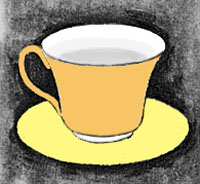
OK now – and so far we take looked at directly lines in perspective – but what about curves? Take a await at this chart…then hold a coin in your manus, flat on to your eyelevel. Slowly turn it away from you and scout what happens to that circle…it becomes more and more than elliptical – the side curves condign more than and more pointy… and then see how this applies to the ovals in the teacup and saucer.
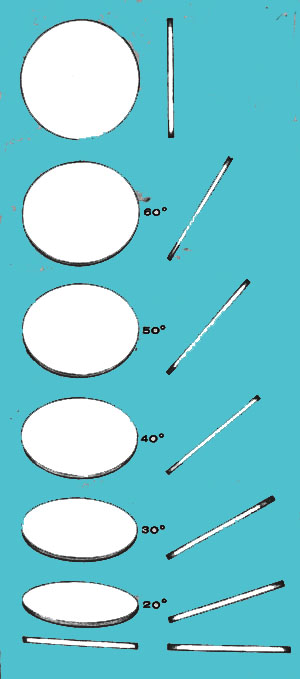
Thus it happens in nature – where the bend in a road or river, or the curve of a bay becomes more pointy or elliptical, the closer to the ground is your viewpoint…(it is so often we come across a painting spoiled past a bay of water that appears to "stand up upward" and non "lay" properly in the mural.) Now you volition know why! Large rounded curves belong with a bird's eye view.
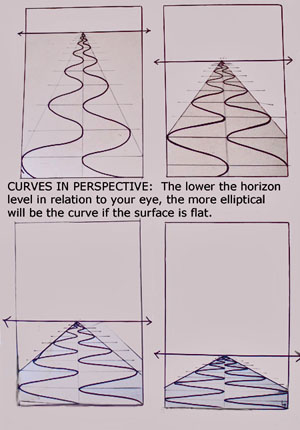
Can you see how the curves are more rounded the higher your viewpoint in relation to the horizon? As shortly equally yous establish a horizon in a landscape yous establish immediately where you are in viewing the scene..the closer to the ground you are the more elliptical or pointed the ovals become.
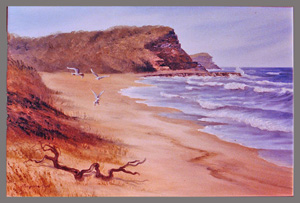
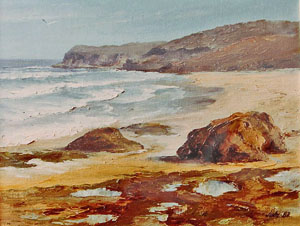
In that location may be merely one curve in a picture but it needs to be "right"… hither's an case "N Avoca Beach" which was a painting commissions many years ago…find I have had to do 2 things: get the overall scallop of the water edge right (each line of waves post-obit suit) and slope the beach downwardly to it (after all that is what is stopping the water from flowing further!) This was easier to assess because I painted information technology on location right at the scene…
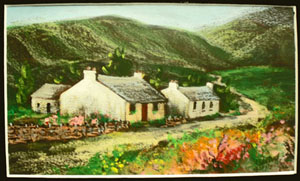
In this adjacent painting the perspective is in a road and some houses and I have had to make allowances for the hilly terrain as the route snakes its way upwardly into the hills. Very often the ground is not level and nosotros accept to brand adjustments in the drawing through close observation. "Glengariff cottages" was a small-scale report from our visit to Ireland .
Every bit well as making things appearing smaller as they get farther away from you, they become less singled-out (less visible detail), making things in the distance become lighter in tone – so this is a way you tin add together to your illustion of perspective in a painting – graduating your darks from the foreground softer and softer into the distance. Hither are some demonstrations from my drove, which I pushed a bit to indicate the hazy atmosphere of the twenty-four hour period.
The difficulty of painting from photographs is that the camera tends non to give you this tonal softness or details within shadows (it makes them more than blackness/dk grey) so we as artists, need to exist aware of this and compensate where needed…
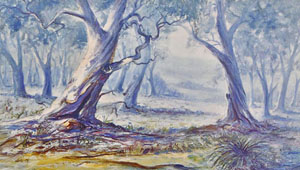
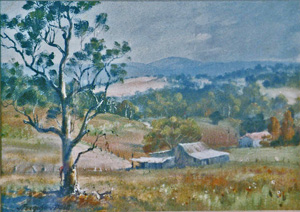
Some other affair to realise is that as things get close to yous they overlap what lies behind them, roofing upwards part of the shape backside. Here is a landscape to show you what I hateful. First the initial sketch…
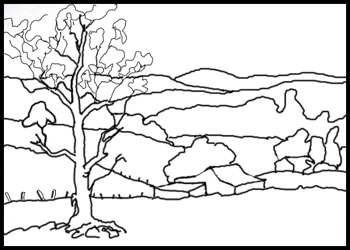
and at present the finished painting…(Gloucester hills). Can you lot still run into the overlapping?
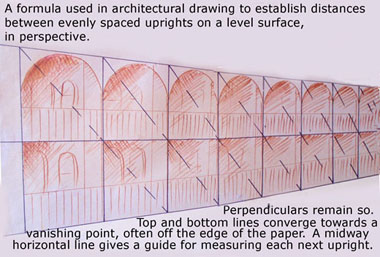
Now if you are demand to do more precise architectural cartoon, there is a formula for spacing uprights towards a vanishing betoken. It might be contend posts, poles, tenament buildings or like. I oasis't had to apply it much, but it might be useful for someone to include information technology here. My chart isn't exact (my perpendicular lines shouldn't lean over) but it should exist enough to give you lot the idea. You have to judge or measure out the first segment at left, then you tin find a midway point and by cartoon a diagonal line through it you will find where the side by side segment upright volition be. Information technology tin apply to fence posts, telegraph poles, buildings – anything uniform. Of course the consequence wil vary depending on your first ii lines meridian and lesser which converge to a vanishing point (in this case, outside the area of the drawing).
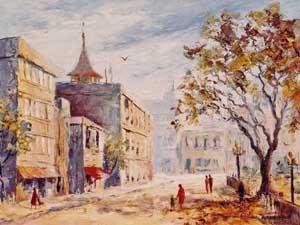
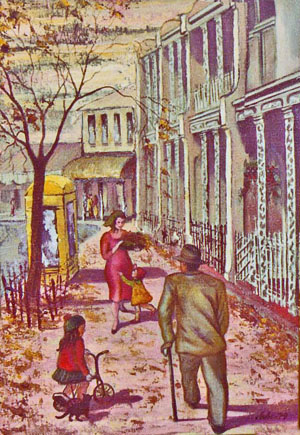
Without existence too architecturally exact, I broadly used the above formula in the following painting of Sydney "Rocks" area in autumn…
Finally, there is the difficulty of placing figures in a mural and getting them the right size for their positioning. This tin can exist very catchy. To have some sort of "norm" from which to bounce is virtually the but mode I know of to manage it. Since the height and shape of different people varies so much, I find it most helpful to institute first where their anxiety would be then that they are not 'floating' in the painting!
From at that place I like to put a mark where the top of their head would come up to, imagining I were in the painting and how loftier I would be in relation to other things in the composition. e.g. a doorway of a edifice or a tree.
Having put down those two marks for the top of the caput and the anxiety, I and so identify a midway mark for a continuing figure which represents the half-style hip mark. I can and so more than easily sketchin the figure in the right proportions, beingness careful to avoid the common trap of making the caput too large. Once figures are placed correctly, a shadow "anchoring" them to the footing level helps complete the illusion.
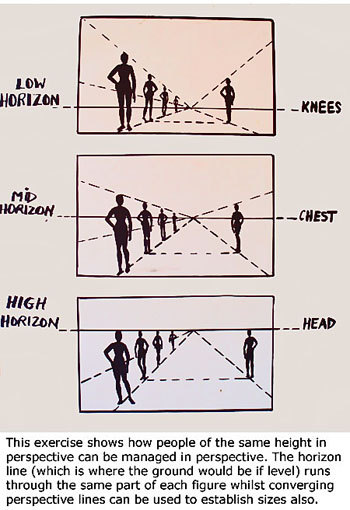
Of course, if y'all were sketching people of much the aforementioned height (due east.m. soldiers marching etc.) you could use the chart below which puts the "horizon" line through the same part of each person'southward torso…
For those of y'all interested in methods the cartoonists utilise to achieve the illusion of huge towering buildings or massive chasms – in that location is three point perspective at play!
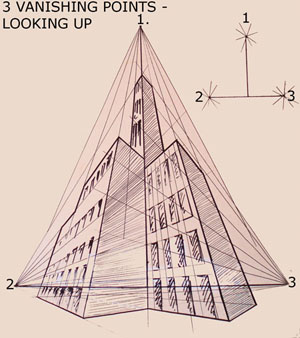
Actually the above instance is even get-go to take in a fourth vanishing point below the horizon line from 2 to 3!
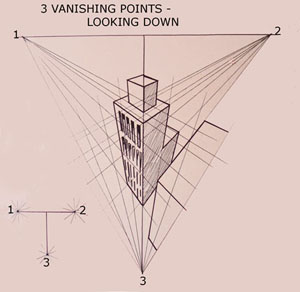
Here is is a 'birdseye' view looking down with 3 vanishing points:
Now here's a hard 1 – supposing you need to describe a pile of boxes all thrown higgled-piggly in a pile! Because they would not be flat a level surface, each would have its own unlike angles … therefore at that place could be multiple vanishing points & most of them out of the limerick! What could you lot do so to draw such a subject?
Well, we can always fall back on the "clock mitt" method shown earlier to assess each line as coming from the heart of a clock in relation to the sides of your newspaper. If circuitous and confusing, try segmenting the area into a grid of four and deal with each quarter on its own.
Whatever your need to apply this illusion called perspective, I hope something in this Post has helped yous.
One terminal tip:
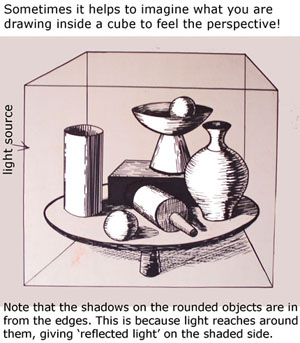
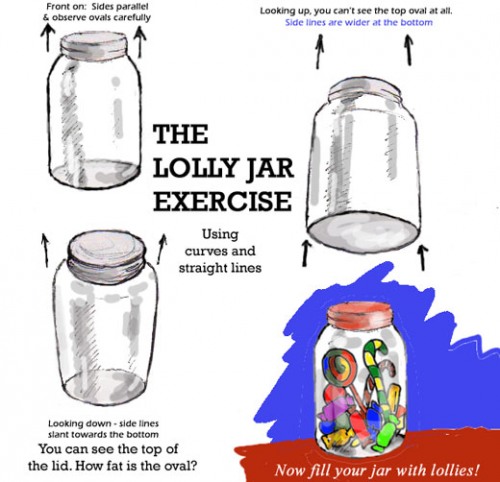
In response to a asking, hither is an case of drawing a Lolly Jar from 3 angles. Because it isn't a huge object (like a loftier rise building) at that place is no demand for 3 signal perspective only because curves are involved too as straight lines, information technology is a good exercise:
If y'all would actually like to see the illusion of perspective in action, check out the miraculous 3D chalk art by Pavement Artists such as Julian Beever and Edgar Mueller.
I promise this Post has been helpful to y'all.
Cheers! Julie
<< Dorsum to Office ane Perspective Drawing Tutorial
Tutorial created by Julie Duell
Visit Julie's Websites Today:
https://artintegrity.wordpress.com/ – This is Julies main Website. This is a great site loaded with free art lessons. Brand sure you end by her Sales Gallery Hither where you tin purchase her beautiful artwork.
https://world wide web.kidsfuncorner.com/ – Free site designed for children, teachers and parents. Julie has fun animative stories and creating learning aids that are fun, as well as giving kids an opportunity to showcase their work….

Source: https://www.artinstructionblog.com/perspective-drawing-tutorial-for-artists-part-2
Posted by: rickerwhimere.blogspot.com
0 Response to "How To Draw Something Curved In Two Point Perspevtive"
Post a Comment